

A Broader Historical Canvas
Stepping into a new mainline entry after more than a decade of expansions feels strange at first. The map opens in the late Middle Ages, pulling the timeline earlier into the collapse of old dynasties and the eruption of the Hundred Years' War. You can sit in control of a massive empire like the Yuan Dynasty or steer a modest Italian city-state through regional rivalries. The interface is clean and entirely in English, though players looking for English voice work should note that voice overs are absent. That omission barely registers once you get down to the business of reading ledgers, sorting out treaty obligations, and watching borders shift across Europe and Asia.
The opening decades of a campaign carry a distinctly slower, more deliberate rhythm than older entries. You are not simply painting provinces your national color right out of the gate. Expanding your borders requires careful groundwork through diplomacy, fabricating or pressing valid claims, and watching how neighboring rivals react before you march a single regiment across a border. It feels grounded in historical reality, giving smaller societies and feudal clans in Japan room to maneuver before global trade networks kick into gear.

Managing the Home Front and the Estates
The internal management of your country takes up a massive portion of your attention, and for good reason. Estates represent the distinct factions inside your borders, each with their own demands and levers of influence. Granting concessions to your nobility might secure quick military levies for an urgent war, but it strips away crown authority and bites into your seasonal tax collections down the road. Cross the burghers or the clergy, and your domestic stability drops, opening the door to civil unrest right when an external enemy decides to test your borders.
Balancing these domestic factions creates genuine tension between foreign wars and internal peace. There were stretches in my England game where I had to ignore French provocations across the channel simply because my domestic estates were furious over war taxes. You cannot treat your country like a blank slate. If you neglect your home factions while chasing glory overseas, your internal economy stalls out and your governing power dries up completely, leaving you unable to enact even basic administrative decrees until you buy back their loyalty with costly privileges.

Supplies, Armies, and Logistical Weight
Warfare has undergone a substantial rethink, shifting away from mindless stack wiping toward logistical planning. Armies need regular supplies, and moving large hosts through rugged terrain or winter provinces drains your manpower reserves faster than pitched battles do. You must consider how far your supply lines stretch from friendly territory, meaning a reckless march deep into Russia can shatter an invading force before it ever reaches a fortress wall. Fortresses themselves demand sustained sieges that tie up valuable regiments for years, giving defenders time to rally relief forces or hire mercenaries.
Combat resolution rewards preparation over raw numbers. Terrain, leader traits, and troop composition all play measurable roles, but logistics decide who can actually sustain a prolonged conflict. In one campaign, a promising offensive into continental Europe collapsed simply because my supply train could not keep pace with my cavalry vanguard, stranding my best units without reinforcements while local garrisons cut off their retreat. It forces you to build supply depots and pace your territorial advances rather than sprinting across the map.
Trade Networks and Five Centuries of Change
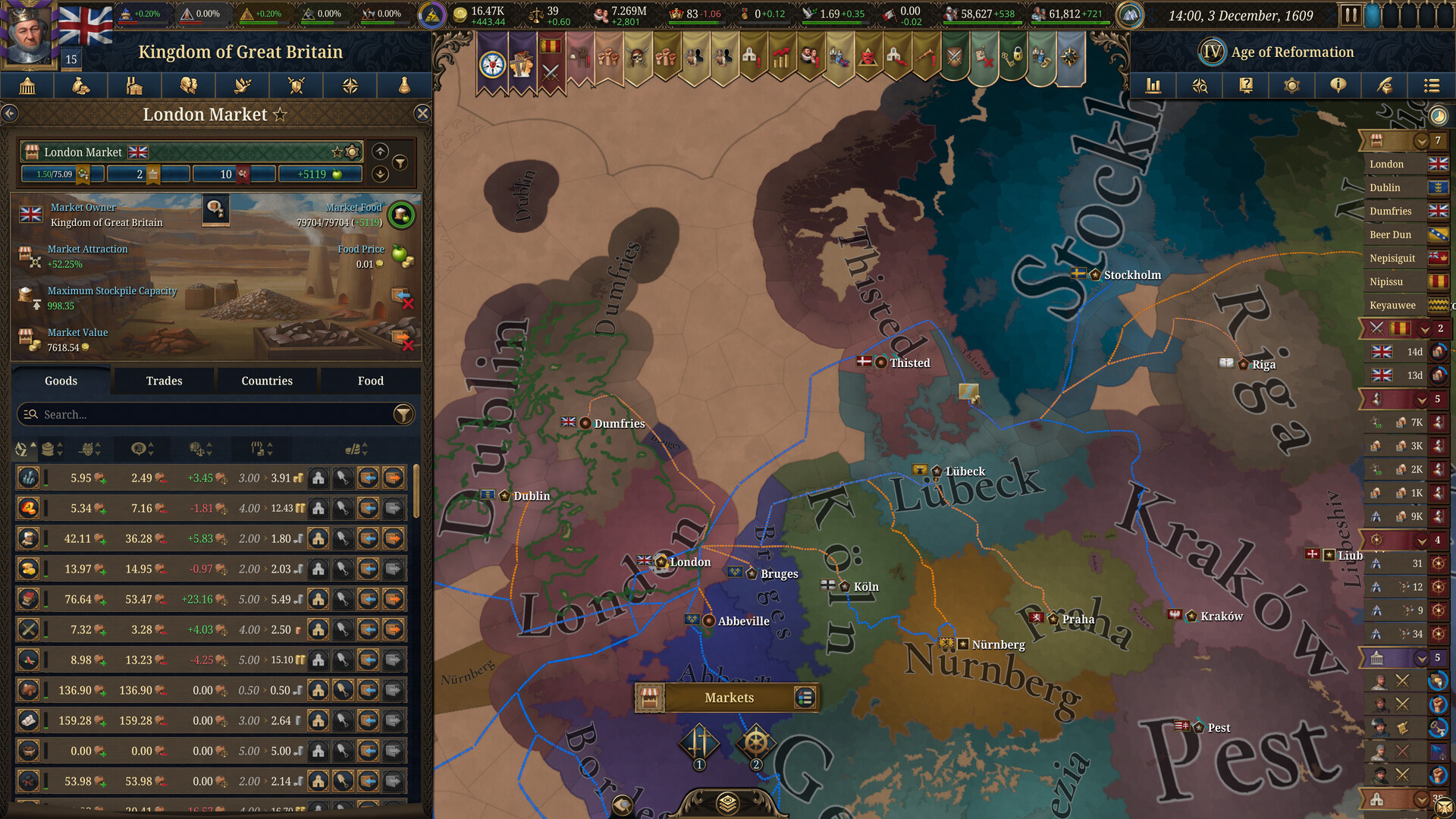
The revised economic model ties commerce directly into how goods move between markets. Trade nodes feel less like abstract collection points and more like living commercial hubs where merchant fleets compete for valuable commodities. Diverting trade from Asia or the Mediterranean back to home ports requires sustained investment in light ships, merchant posts, and friendly harbor access. When the Protestant Reformation arrives in the mid-game, it fractures these commercial pacts alongside religious alliances, turning old trading partners into bitter ideological rivals overnight.
At $47.99 on Steam, the package offers an enormous amount of strategic depth right out of the box, even if the learning curve remains steep for newcomers. Tooltips explain most interconnected systems clearly, yet the sheer volume of choices can cause decision fatigue during long play sessions. Watching five hundred years of alternate history play out from the late medieval chaos to the Age of Revolution remains deeply satisfying. Paradox Tinto has delivered a thoughtful, demanding strategy foundation that respects the player's time and intellect.


Comments 22
BestNewest★ Best comments
Ha, my army starved and then revolted. So much for 'they didn't revolt yet'.
The internal politics are proper dark. Felt like I was playing Game of Thrones, but with more taxes. Honestly, the estates system is a proper bitter storyline.
Too right, mate. That first army starve is a gut punch. I had to step back and rethink my whole approach. Keep some tissues handy if you're starting a campaign.
Calling the estate system 'meaningful domestic tension' is pure exaggeration. It just adds extra clicks that get in the way of the core spreadsheet map painting. Supply lines work fine, but they don't feel that different from EU4 anyway. Rating this an 8.6 is way too generous for what feels like a sidegrade.
Strewth, the review makes it sound like a real thinker's game. I appreciate the depth but I'm worried about the menus being too dense. Still, the estate system sounds like it could be fun to manage. The fact that you have to feed your troops is a nice touch. Might give it a go after I finish my current card game.
deepens the strategy ledger lol that phrase alone makes me think of homework. but the supply system sounds cool i guess. my group would just talk over everything so maybe not for us.
The internal politics are proper dark. Felt like I was playing Game of Thrones, but with more taxes. Honestly, the estates system is a proper bitter storyline.
No voice acting is a shame, but I guess it lets me narrate my own epic. My campaigns are now a one-man show with voices for each advisor.
y'all are fixin to be real mad about these menus. they got layers like an onion and it stinks. but the gameplay underneath is solid. just gotta peel em back.
y'all just need to check your supply capacity before moving. also keep a few units in key provinces to keep estates from revolting. works for me.
u guys are crazy the estates are fine rn. just delegate and focus on war. it's not that complicated.
y'all are fixin to be real disappointed with the estate system if you're looking for a chill game. it's always something.
menus are too much for me lol. i just want to fight wars not manage supplies. but the game seems well made i guess.
@hjw06Hate to break it to you, but if you want to fight wars you gotta feed the troops. The menus are just the paperwork behind the glory.
Forty-eight bucks is a bit steep for me right now. I'm fixin to wait for a sale, but it sounds like a solid game. For that price I could get a few breakfast platters, so it better give me plenty of hours.
The learning curve is less a curve and more of a cliff. A very dry, bureaucratic cliff.
@cr91The learning cliff is real. It's basically a sheer brick wall with zero hand-holding, you just smash right into it until the supply mechanics finally click.
solid b-minus tier. the supply system is legit but the menus are a mess. learning curve is steep but if you can handle it the payoff is there. estates feel like a chore sometimes. not bad for a paradox game.
@TariqI'm curious about the estates. Do they always rebel if you don't give them power? Trying to find the right balance.
The supply lines hit me right in the feels. My first army starved and I actually felt bad watching them die in the cold, ngl it kinda ruined my whole night.
@ola_ollieHa, my first army starved too. At least they didn't revolt. Yet.
@Rory PI'm curious about that too. Does the game get easier once you understand the supply system? I'm still in the learning phase.
@bkw92It does get easier in the sense that you learn to read the supply map and plan your moves. The early game is about learning those patterns. Once you do, the system becomes a rewarding layer of strategy, but don't expect it to ever become trivial. That's the point.
@ola_ollieHa, my army starved and then revolted. So much for 'they didn't revolt yet'.
@ola_ollieToo right, mate. That first army starve is a gut punch. I had to step back and rethink my whole approach. Keep some tissues handy if you're starting a campaign.